A Solar Prominence Erupts in STEREO


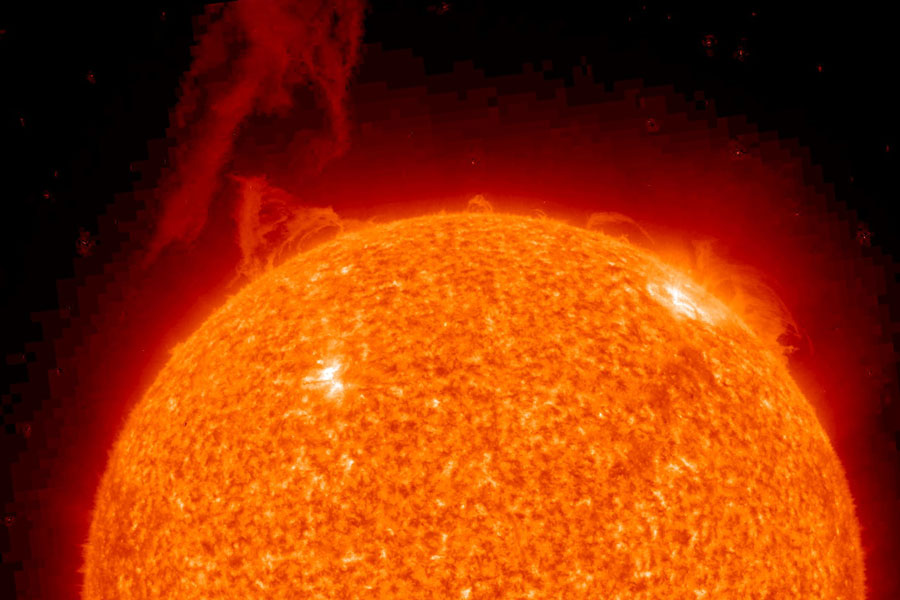
What does a solar prominence look like in three dimensions? To help find out, NASA launched the STEREO satellites to keep a steady eye on the Sun from two different vantage points. The STEREO satellites orbit the Sun nearly along Earth's orbit, but one (dubbed Ahead) currently leads the Earth, while the other (dubbed Behind) currently trails. Three weeks ago, a powerful prominence erupted and remained above the Sun for about 30 hours, allowing the STEREO satellites to get numerous views of the prominence from different angles. Pictured above is a high-resolution image of the event from the STEREO Ahead satellite. A video of the prominence erupting as seen from both spacecraft can be found here. The unusually quiet nature of the Sun over the past two years has made large prominences like this relatively rare. The combined perspective of STEREO will help astronomers better understand the mechanisms for the creation and evolution of prominences, coronal mass ejections, and flares.

Posted by scurvy | at 2:18 AM | 0 comments

Great Observatories Explore Galactic Center


Where can a telescope take you? Four hundred years ago, a telescope took Galileo to the Moon to discover craters, to Saturn to discover rings, to Jupiter to discover moons, to Venus to discover phases, and to the Sun to discover spots. Today, in celebration of Galileo's telescopic achievements and as part of the International Year of Astronomy, NASA has used its entire fleet of Great Observatories, and the Internet, to bring the center of our Galaxy to you. Pictured above, in greater detail and in more colors than ever seen before, are the combined images of the Hubble Space Telescope in near-infrared light, the Spitzer Space Telescope in infrared light, and the Chandra X-ray Observatory in X-ray light. A menagerie of vast star fields is visible, along with dense star clusters, long filaments of gas and dust, expanding supernova remnants, and the energetic surroundings of what likely is our Galaxy's central black hole. Many of these features are labeled on a complementary annotated image. Of course, a telescope's magnification and light-gathering ability create only an image of what a human could see if visiting these places. To actually go requires rockets.

Posted by scurvy | at 2:07 AM | 0 comments

Nereus Crater on Mars


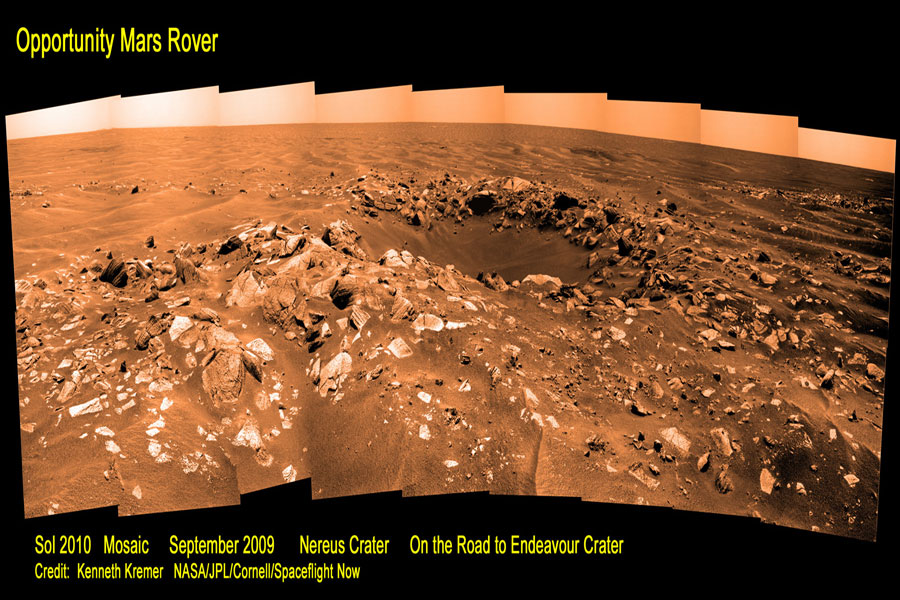
It was along the way. The robotic rover Opportunity currently rolling across the Meridiani Plain on Mars has a destination of Endeavour Crater, a large crater over 20 kilometers across which may yield additional clues about the cryptic past of ancient Mars. Besides passing open fields of dark soil and light rock, Opportunity has chanced upon several interesting features. One such feature, pictured above in a digitally stitched and horizontally compressed panorama, is Nereus Crater, a small crater about 10 meters across that is surrounded by jagged rock. Besides Nereus, Opportunity recently also happened upon another unusual rock -- one that appears to be the third large meteorite found on Mars and the second for Opportunity during only this trip. Opportunity has been traveling toward Endeavour Crater for over a year now, and if it can avoid ridged rocks and soft sand along the way, it may reach Endeavour sometime next year.

Posted by scurvy | at 10:36 AM | 0 comments

Ring Nebula Deep Field


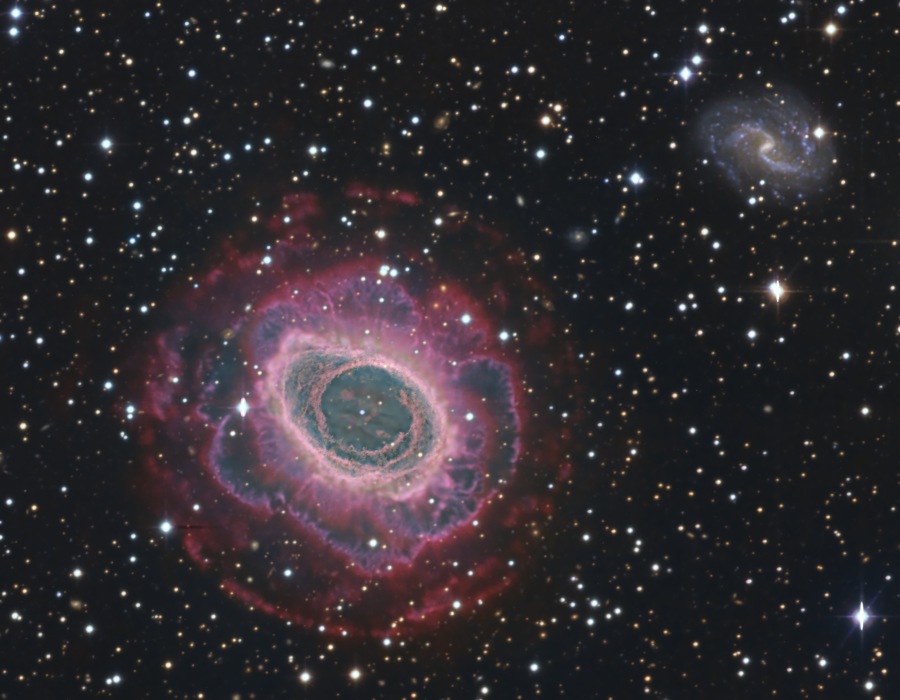
A familiar sight to sky enthusiasts with even a small telescope, the Ring Nebula (M57) is some 2,000 light-years away in the musical constellation Lyra. The central ring is about one light-year across, but this remarkably deep exposure - a collaborative effort combining data from three different telescopes - explores the looping filaments of glowing gas extending much farther from the nebula's central star. Of course, in this well-studied example of a planetary nebula, the glowing material does not come from planets. Instead, the gaseous shroud represents outer layers expelled from a dying, sun-like star. This remarkable composite image includes narrowband image data recording the Ring's atomic hydrogen emission (shown as violet) in visible light and molecular hydrogen emission (shown as red) at near infrared wavelengths. The much more distant spiral galaxy IC 1296 is also visible at the upper right.

Posted by scurvy | at 10:27 AM | 0 comments

Seven Sisters Versus California


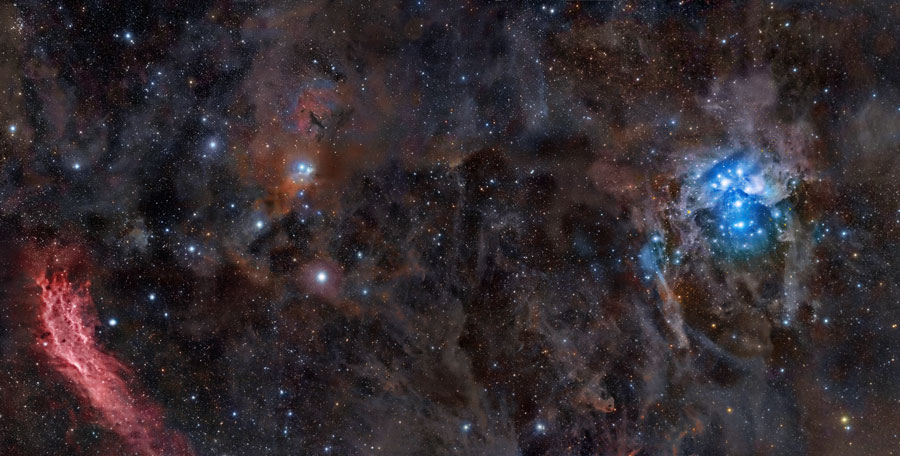
On the upper right, dressed in blue, is the Pleiades. Also known as the Seven Sisters and M45, the Pleiades is one of the brightest and most easily visible open clusters on the sky. The Pleiades contains over 3,000 stars, is about 400 light years away, and only 13 light years across. Surrounding the stars is a spectacular blue reflection nebula made of fine dust. A common legend is that one of the brighter stars faded since the cluster was named. On the lower left, shining in red, is the California Nebula. Named for its shape, the California Nebula is much dimmer and hence harder to see than the Pleiades. Also known as NGC 1499, this mass of red glowing hydrogen gas is about 1,500 light years away. Although about 25 full moons could fit between them, the above wide angle, deep field image composite has captured them both.

Posted by scurvy | at 10:18 AM | 0 comments

Water Discovered in Moon Shadow


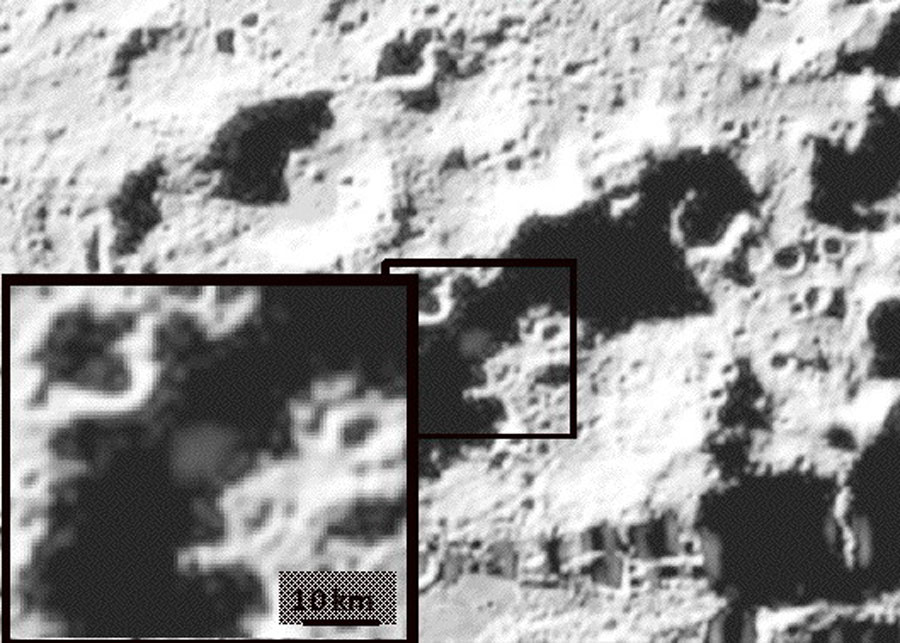
Why is there water on the Moon? Last month, the LCROSS mission crashed a large impactor into a permanently shadowed crater near the Moon's South Pole. A plume of dust rose that was visible to the satellite, although hard to discern from Earth. The plume is shown above in visible light. Last week, the results of a preliminary chemical analysis gave a clear indication that the dust plume contained water. Such water is of importance not only for understanding the history of the Moon, but as a possible reservoir for future astronauts trying to live on the Moon for long periods. The source of the lunar water is now a topic of debate. Possible origins include many small meteorites, a comet, or primordial moon soil.

Posted by scurvy | at 10:14 AM | 0 comments

Saturn After Equinox


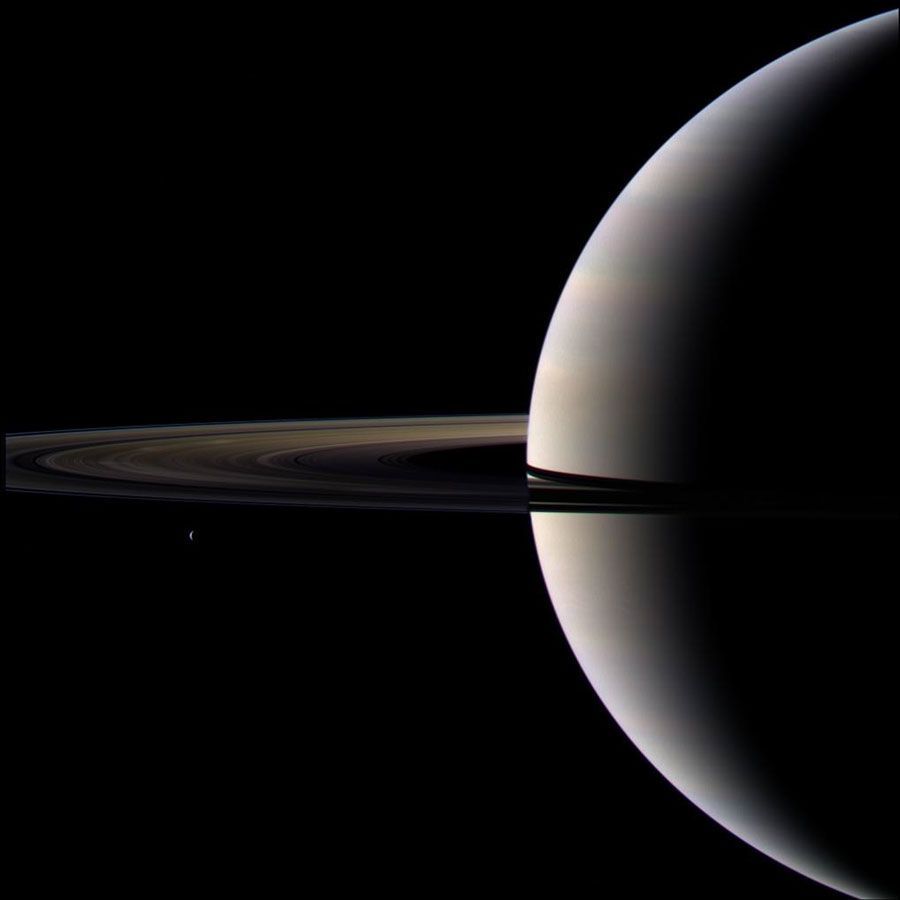
The other side of Saturn's ring plane is now directly illuminated by the Sun. For the previous 15 years, the southern side of Saturn and its rings were directly illuminated, but since Saturn's equinox in August, the orientation has reversed. Pictured above last month, the robotic Cassini spacecraft orbiting Saturn has captured the giant planet and its majestic rings soon after equinox. Imaged from nearly behind, Saturn and its moon Tethys each show a crescent phase to Cassini that is not visible from Earth. As the rings continue to point nearly toward the Sun, only a thin shadow of Saturn's rings is visible across the center of the planet. Close inspection of Saturn's rings, however, shows superposed bright features identified as spokes that are thought to be groups of very small electrically charged ice particles. Understanding the nature and dynamics of spokes is not fully understood and remains a topic of research.

Posted by scurvy | at 4:09 AM | 0 comments

Goodbye Earth.


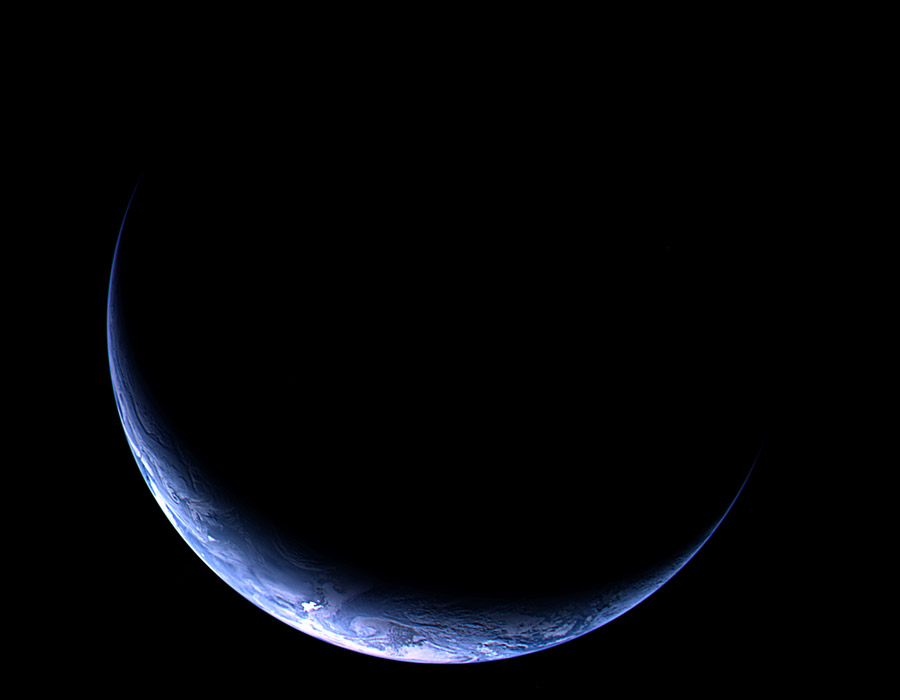
Earlier this month, ESA's interplanetary Rosetta spacecraft zoomed past the Earth on its way back across the Solar System. Pictured above, Earth showed a bright crescent phase featuring the South Pole to the passing rocket ship. Launched from Earth in 2004, Rosetta used the gravity of the Earth to help propel it out past Mars and toward a 2014 rendezvous with Comet Churyumov-Gerasimenko. Last year, the robot spacecraft passed asteroid 2867 Steins, and next year it is scheduled to pass enigmatic asteroid 21 Lutetia. If all goes well, Rosetta will release a probe that will land on the 15-km diameter comet in 2014.

Posted by scurvy | at 3:52 AM | 0 comments

NASA Space Telescope Discovers Largest Ring Around Saturn


PASADENA, Calif. -- NASA's Spitzer Space Telescope has discovered an enormous ring around Saturn -- by far the largest of the giant planet's many rings.

The new belt lies at the far reaches of the Saturnian system, with an orbit tilted 27 degrees from the main ring plane. The bulk of its material starts about six million kilometers (3.7 million miles) away from the planet and extends outward roughly another 12 million kilometers (7.4 million miles). One of Saturn's farthest moons, Phoebe, circles within the newfound ring, and is likely the source of its material.

Saturn's newest halo is thick, too -- its vertical height is about 20 times the diameter of the planet. It would take about one billion Earths stacked together to fill the ring.

"This is one supersized ring," said Anne Verbiscer, an astronomer at the University of Virginia, Charlottesville. "If you could see the ring, it would span the width of two full moons' worth of sky, one on either side of Saturn." Verbiscer; Douglas Hamilton of the University of Maryland, College Park; and Michael Skrutskie, of the University of Virginia, Charlottesville, are authors of a paper about the discovery to be published online tomorrow by the journal Nature.

An artist's concept of the newfound ring is online at http://www.nasa.gov/mission_pages/spitzer/multimedia/spitzer-20091007a.html .

The ring itself is tenuous, made up of a thin array of ice and dust particles. Spitzer's infrared eyes were able to spot the glow of the band's cool dust. The telescope, launched in 2003, is currently 107 million kilometers (66 million miles) from Earth in orbit around the sun.

The discovery may help solve an age-old riddle of one of Saturn's moons. Iapetus has a strange appearance -- one side is bright and the other is really dark, in a pattern that resembles the yin-yang symbol. The astronomer Giovanni Cassini first spotted the moon in 1671, and years later figured out it has a dark side, now named Cassini Regio in his honor. A stunning picture of Iapetus taken by NASA's Cassini spacecraft is online at http://saturn.jpl.nasa.gov/photos/imagedetails/index.cfm?imageId=2763.

Saturn's newest addition could explain how Cassini Regio came to be. The ring is circling in the same direction as Phoebe, while Iapetus, the other rings and most of Saturn's moons are all going the opposite way. According to the scientists, some of the dark and dusty material from the outer ring moves inward toward Iapetus, slamming the icy moon like bugs on a windshield.

"Astronomers have long suspected that there is a connection between Saturn's outer moon Phoebe and the dark material on Iapetus," said Hamilton. "This new ring provides convincing evidence of that relationship."

Verbiscer and her colleagues used Spitzer's longer-wavelength infrared camera, called the multiband imaging photometer, to scan through a patch of sky far from Saturn and a bit inside Phoebe's orbit. The astronomers had a hunch that Phoebe might be circling around in a belt of dust kicked up from its minor collisions with comets -- a process similar to that around stars with dusty disks of planetary debris. Sure enough, when the scientists took a first look at their Spitzer data, a band of dust jumped out.

The ring would be difficult to see with visible-light telescopes. Its particles are diffuse and may even extend beyond the bulk of the ring material all the way in to Saturn and all the way out to interplanetary space. The relatively small numbers of particles in the ring wouldn't reflect much visible light, especially out at Saturn where sunlight is weak.

"The particles are so far apart that if you were to stand in the ring, you wouldn't even know it," said Verbiscer.

Spitzer was able to sense the glow of the cool dust, which is only about 80 Kelvin (minus 316 degrees Fahrenheit). Cool objects shine with infrared, or thermal radiation; for example, even a cup of ice cream is blazing with infrared light. "By focusing on the glow of the ring's cool dust, Spitzer made it easy to find," said Verbiscer.

These observations were made before Spitzer ran out of coolant in May and began its "warm" mission.

NASA's Jet Propulsion Laboratory, Pasadena, Calif., manages the Spitzer Space Telescope mission for NASA's Science Mission Directorate, Washington. Science operations are conducted at the Spitzer Science Center at the California Institute of Technology, also in Pasadena. Caltech manages JPL for NASA. The multiband imaging photometer for Spitzer was built by Ball Aerospace Corporation, Boulder, Colo., and the University of Arizona, Tucson. Its principal investigator is George Rieke of the University of Arizona.

For additional images relating to the ring discovery and more information about Spitzer, visit http://www.spitzer.caltech.edu/spitzer/ and http://www.nasa.gov/mission_pages/spitzer/main/index.html.
Posted by scurvy | at 2:51 AM | 0 comments

NASA's Ares I-X Rocket Completes Successful Flight Test


CAPE CANAVERAL, Fla. -- NASA's Ares I-X test rocket lifted off at 11:30 a.m. EDT Wednesday from NASA's Kennedy Space Center in Florida for a two-minute powered flight. The test flight lasted about six minutes from its launch from the newly-modified Launch Complex 39B until splash down of the rocket's booster stage nearly 150 miles down range.

"This is a huge step forward for NASA's exploration goals," said Doug Cooke, associate administrator for the Exploration Systems Mission Directorate at NASA Headquarters in Washington. "Ares I-X provides NASA with an enormous amount of data that will be used to improve the design and safety of the next generation of American spaceflight vehicles -- vehicles that could again take humans beyond low Earth orbit."

The 327-foot tall Ares I-X test vehicle produced 2.6 million pounds of thrust to accelerate the rocket to nearly 3 g's and Mach 4.76, just shy of hypersonic speed. It capped its easterly flight at a sub-orbital altitude of 150,000 feet after the separation of its first stage, a four-segment solid rocket booster.

Parachutes deployed for recovery of the booster and the solid rocket motor will be recovered at sea for later inspection. The simulated upper stage, Orion crew module, and launch abort system will not be recovered.

"The most valuable learning is through experience and observation," said Bob Ess, Ares I-X mission manager. "Tests such as this -- from paper to flight -- are vital in gaining a deeper understanding of the vehicle, from design to development."

Wednesday's flight offered an early opportunity to test and prove hardware, facilities, and ground operations - important data for future space vehicles. During the flight, a range of performance data was relayed to the ground and also stored in the onboard flight data recorder. The 700 sensors mounted on the vehicle provide flight test engineering data to correlate with computer models and analysis. The rocket's sensors gathered information in several areas, including assembly and launch operations, separation of the vehicle's first and second stages, controllability and aerodynamics, the re-entry and recovery of the first stage and new vehicle design techniques.

The Ares I-X efforts are led by the Ares I-X mission management office of the Constellation Program, based at NASA's Johnson Space Center in Houston, and NASA's Exploration Systems Mission Directorate in Washington. NASA's Glenn Research Center in Cleveland designed and built the vehicle's upper stage mass simulator. NASA's Langley Research Center in Hampton, Va., provided aerodynamic characterization, flight test vehicle integration and the crew module/launch abort system mass simulator. NASA's Marshall Space Flight Center in Huntsville, Ala., with contractor support, provided management for the development of Ares I-X avionics, roll control, and first stage systems. The Kennedy Space Center provided operations and associated ground activities and launch operations.

Contractors for Ares I-X include Alliant Techsystems, or ATK, of Salt Lake City for the first stage solid rocket booster and Teledyne Brown Engineering of Huntsville for the roll control system. Jacobs Engineering of Tullahoma, Tenn., supported by Lockheed Martin of Denver, provided the avionics systems. United Space Alliance of Houston and ATK Launch Systems support the ground systems and launch operations.

For information about Ares I-X, visit:

http://www.nasa.gov/aresIX

Posted by scurvy | at 2:11 AM | 0 comments