Scurvy's Health & Tech: Bank of Ceylon caught stealing money from user acc...: Money suddenly disappearing from my Bank Of Ceylon account. Sometimes Rs. 5000/- just disappears, another month Rs 3000 vanished. Whe...
Posted by scurvy
|
at
11:20 PM
|

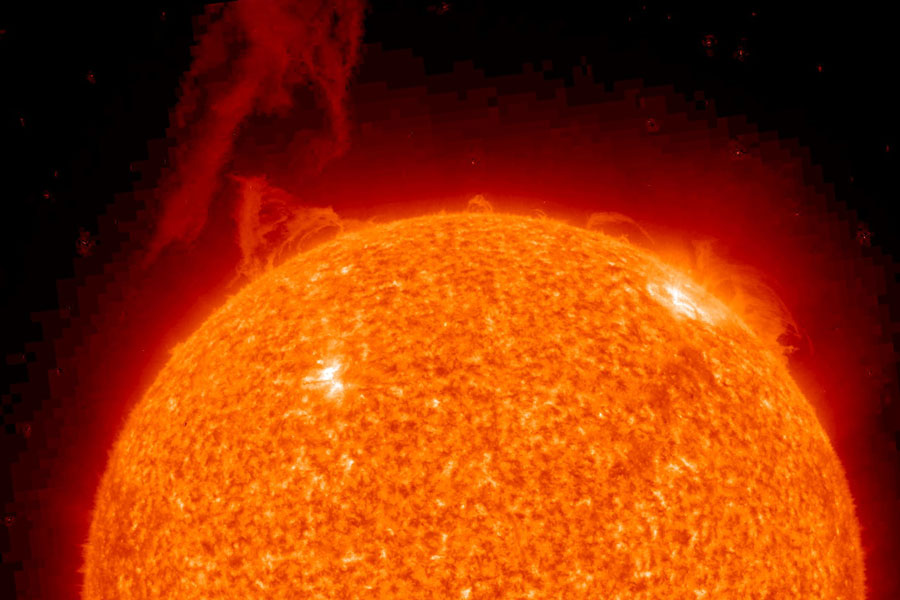
What does a solar prominence look like in three dimensions? To help find out, NASA launched the STEREO satellites to keep a steady eye on the Sun from two different vantage points. The STEREO satellites orbit the Sun nearly along Earth's orbit, but one (dubbed Ahead) currently leads the Earth, while the other (dubbed Behind) currently trails. Three weeks ago, a powerful prominence erupted and remained above the Sun for about 30 hours, allowing the STEREO satellites to get numerous views of the prominence from different angles. Pictured above is a high-resolution image of the event from the STEREO Ahead satellite. A video of the prominence erupting as seen from both spacecraft can be found here. The unusually quiet nature of the Sun over the past two years has made large prominences like this relatively rare. The combined perspective of STEREO will help astronomers better understand the mechanisms for the creation and evolution of prominences, coronal mass ejections, and flares.
Posted by scurvy
|
at
2:18 AM
|

Where can a telescope take you? Four hundred years ago, a telescope took Galileo to the Moon to discover craters, to Saturn to discover rings, to Jupiter to discover moons, to Venus to discover phases, and to the Sun to discover spots. Today, in celebration of Galileo's telescopic achievements and as part of the International Year of Astronomy, NASA has used its entire fleet of Great Observatories, and the Internet, to bring the center of our Galaxy to you. Pictured above, in greater detail and in more colors than ever seen before, are the combined images of the Hubble Space Telescope in near-infrared light, the Spitzer Space Telescope in infrared light, and the Chandra X-ray Observatory in X-ray light. A menagerie of vast star fields is visible, along with dense star clusters, long filaments of gas and dust, expanding supernova remnants, and the energetic surroundings of what likely is our Galaxy's central black hole. Many of these features are labeled on a complementary annotated image. Of course, a telescope's magnification and light-gathering ability create only an image of what a human could see if visiting these places. To actually go requires rockets.
Posted by scurvy
|
at
2:07 AM
|

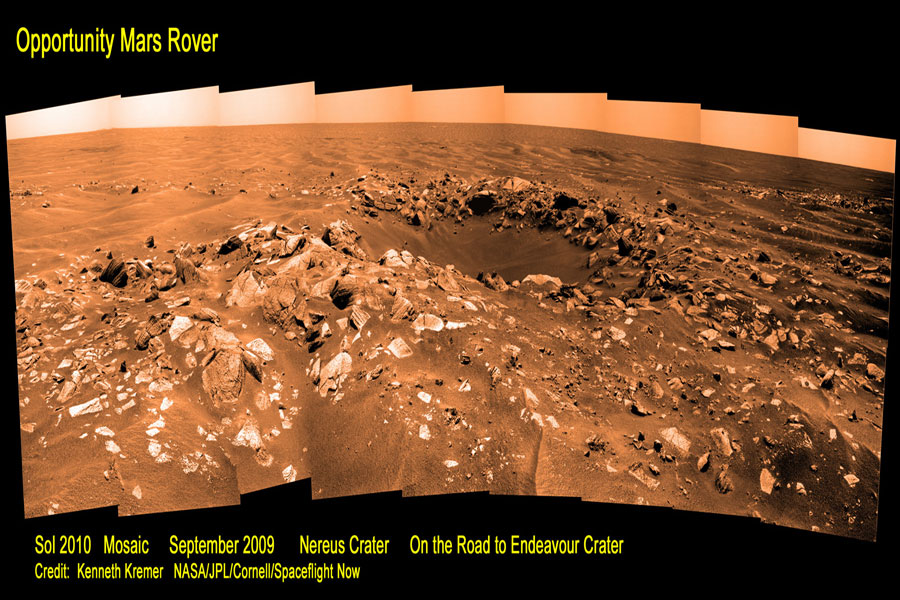
It was along the way. The robotic rover Opportunity currently rolling across the Meridiani Plain on Mars has a destination of Endeavour Crater, a large crater over 20 kilometers across which may yield additional clues about the cryptic past of ancient Mars. Besides passing open fields of dark soil and light rock, Opportunity has chanced upon several interesting features. One such feature, pictured above in a digitally stitched and horizontally compressed panorama, is Nereus Crater, a small crater about 10 meters across that is surrounded by jagged rock. Besides Nereus, Opportunity recently also happened upon another unusual rock -- one that appears to be the third large meteorite found on Mars and the second for Opportunity during only this trip. Opportunity has been traveling toward Endeavour Crater for over a year now, and if it can avoid ridged rocks and soft sand along the way, it may reach Endeavour sometime next year.
Posted by scurvy
|
at
10:36 AM
|

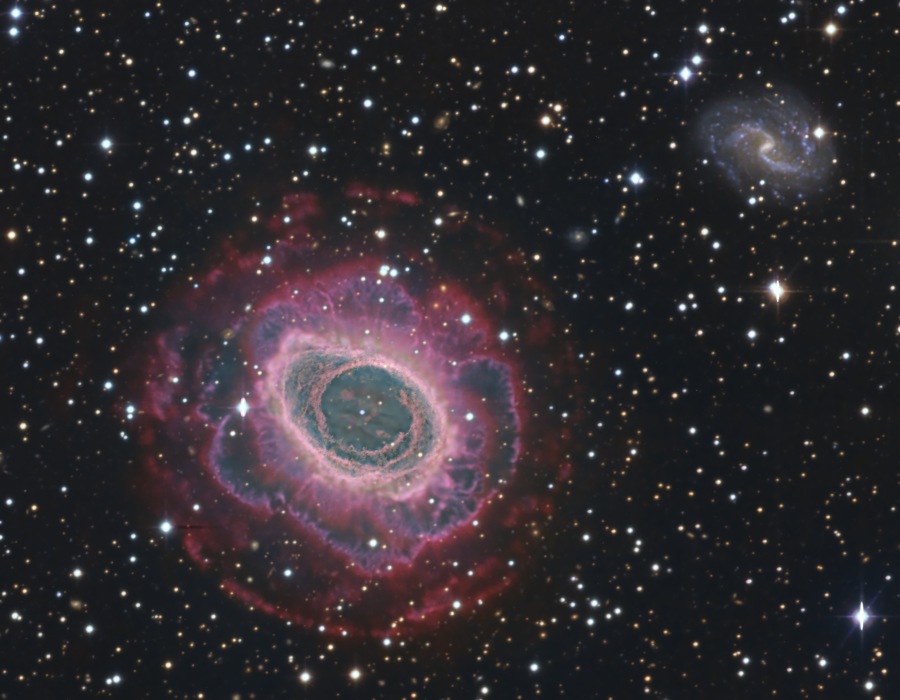
A familiar sight to sky enthusiasts with even a small telescope, the Ring Nebula (M57) is some 2,000 light-years away in the musical constellation Lyra. The central ring is about one light-year across, but this remarkably deep exposure - a collaborative effort combining data from three different telescopes - explores the looping filaments of glowing gas extending much farther from the nebula's central star. Of course, in this well-studied example of a planetary nebula, the glowing material does not come from planets. Instead, the gaseous shroud represents outer layers expelled from a dying, sun-like star. This remarkable composite image includes narrowband image data recording the Ring's atomic hydrogen emission (shown as violet) in visible light and molecular hydrogen emission (shown as red) at near infrared wavelengths. The much more distant spiral galaxy IC 1296 is also visible at the upper right.
Posted by scurvy
|
at
10:27 AM
|

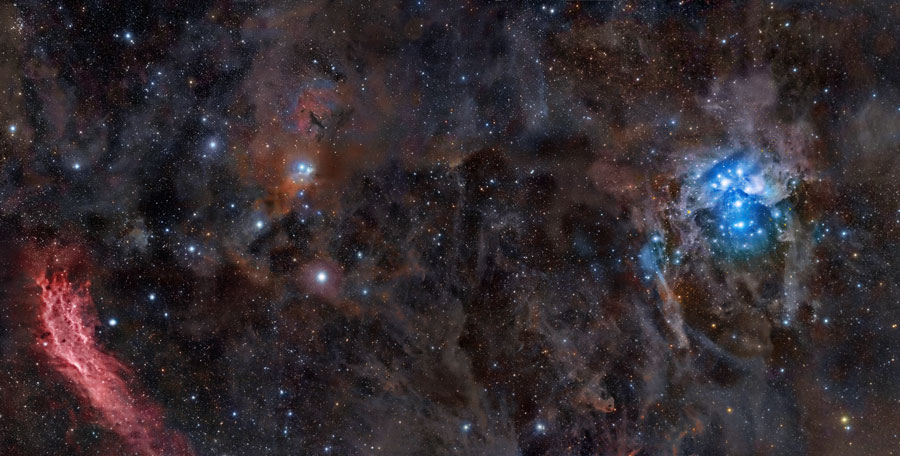
On the upper right, dressed in blue, is the Pleiades. Also known as the Seven Sisters and M45, the Pleiades is one of the brightest and most easily visible open clusters on the sky. The Pleiades contains over 3,000 stars, is about 400 light years away, and only 13 light years across. Surrounding the stars is a spectacular blue reflection nebula made of fine dust. A common legend is that one of the brighter stars faded since the cluster was named. On the lower left, shining in red, is the California Nebula. Named for its shape, the California Nebula is much dimmer and hence harder to see than the Pleiades. Also known as NGC 1499, this mass of red glowing hydrogen gas is about 1,500 light years away. Although about 25 full moons could fit between them, the above wide angle, deep field image composite has captured them both.
Posted by scurvy
|
at
10:18 AM
|

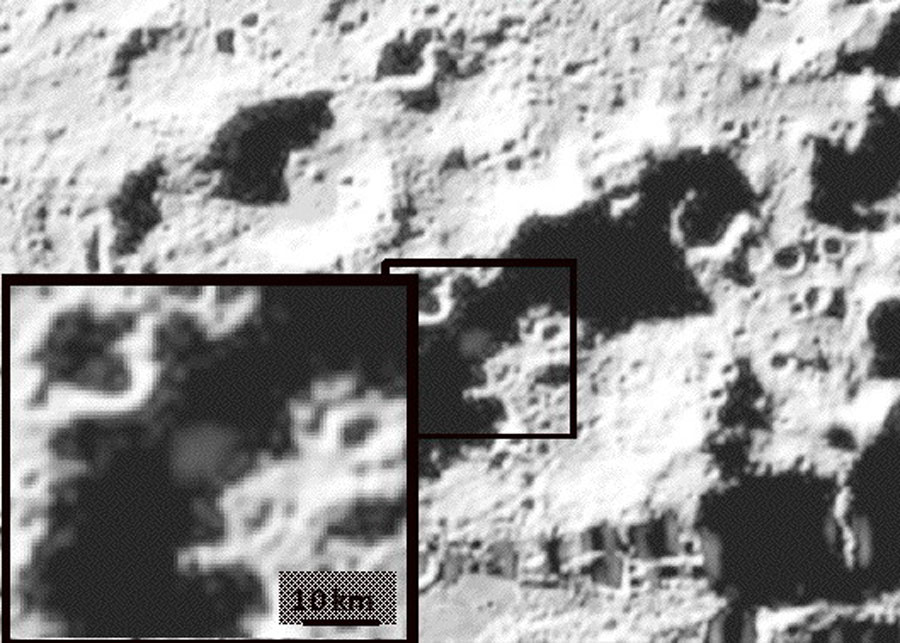
Why is there water on the Moon? Last month, the LCROSS mission crashed a large impactor into a permanently shadowed crater near the Moon's South Pole. A plume of dust rose that was visible to the satellite, although hard to discern from Earth. The plume is shown above in visible light. Last week, the results of a preliminary chemical analysis gave a clear indication that the dust plume contained water. Such water is of importance not only for understanding the history of the Moon, but as a possible reservoir for future astronauts trying to live on the Moon for long periods. The source of the lunar water is now a topic of debate. Possible origins include many small meteorites, a comet, or primordial moon soil.
Posted by scurvy
|
at
10:14 AM
|